You Belong by Sebene Selassie
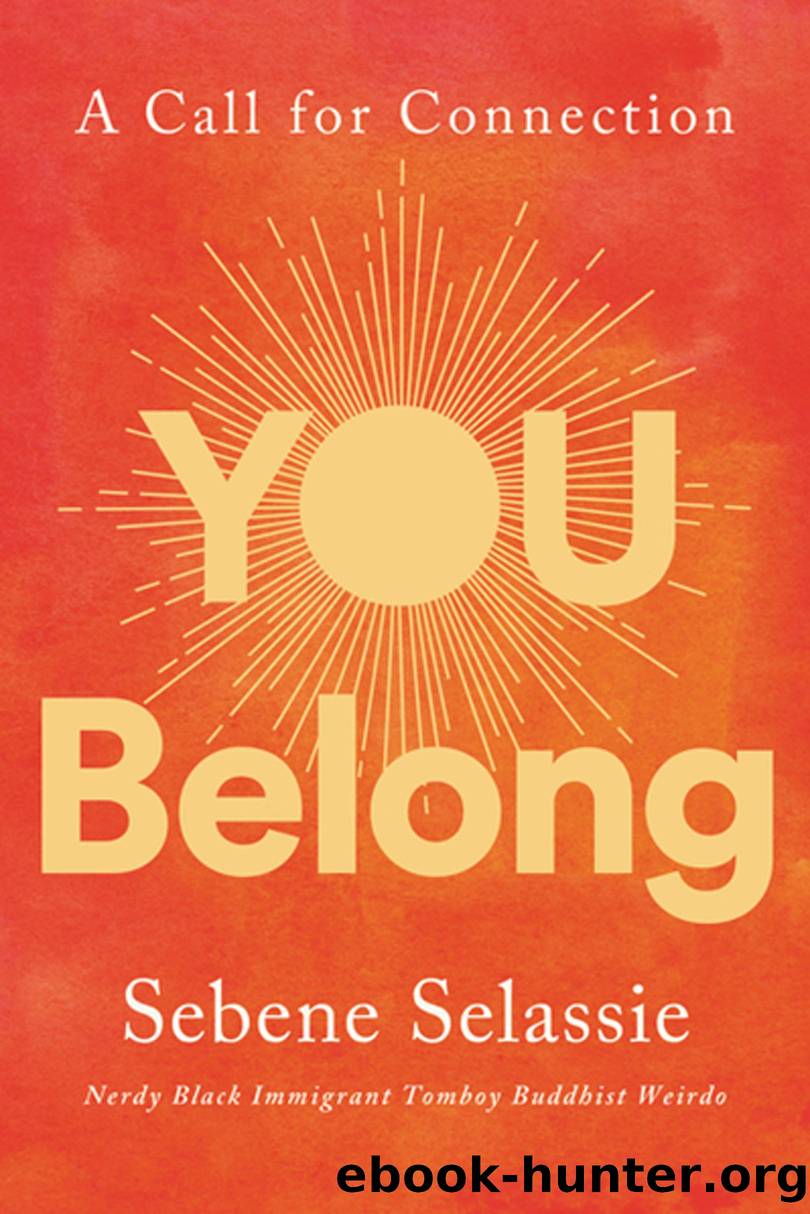
Author:Sebene Selassie
Language: eng
Format: epub
Publisher: HarperCollins
Published: 2020-07-04T00:00:00+00:00
What You Don’t See: Spiritual Bypass and Seeing Our Shadows
There are parts of ourselves that are crystal clear. We know those parts; some we may deem positive and some negative, but we are aware of them. Then there are other parts that we bury deep within. In some schools of psychology, the shadow is a metaphor for parts of ourselves that we have rejected. Here’s one way to look at it: Let’s say the persona is the mask we wear to present to the outside world (I’m a meditation teacher; I’m a father; I’m an artist; I’m the boss)—in other words, how we want the world to see us—and the ego is our intimate sense of self, or who we are to ourselves (I have this biography; I’ve had these experiences throughout my life; I’m an angry/sad/happy/confident person), then our shadows would be the parts of ourselves that we’ve disowned, things that we don’t see and, in fact, mostly don’t want to see about ourselves. They include things we reflexively refuse or deny. The shadow contains things about us that are largely, if not entirely, unconscious. But we can work to see and integrate them.
Yes, we also belong to our shadow.
When we’re young, the shadow holds the things that our parents, families, communities, and cultures deem unacceptable. Perhaps you received messages that it’s not okay to be angry, or openly sexual, or show too much emotion, or be bold or assertive. Or maybe it was really not okay to fail in your family. So, you buried those parts or keep them at bay or pretty tamped down. Or maybe in your family it wasn’t okay to be too healthy or too together—a certain amount of dysfunction was the norm (I can certainly identify with that). It’s not only so-called negative traits that end up in the shadow—often there’s a baseline of what’s accepted in a culture, and anything less than or greater than this ends up in the shadow. And sometimes, especially for certain people and groups, it’s actually even harder to see and own the positive that’s buried in the shadow. In this culture, it can be hard for a woman to exert power—she won’t be called “assertive” like a man would, she’ll be called overly emotional or “a bitch.”
There are different sorting processes for what is acceptable or not depending on a community’s norms. We get different messages depending on gender, race, class, size, and personality. In some cultures or communities, it’s good to be an individual and stand out and shine; in others, this is seen as negative (egotistical, self-centered, even selfish). In some cultures, it’s the norm to be physical and touch people; in others, it’s very discouraged. On the receiving end for individuals, especially for kids, much of the sorting process for these messages of what’s acceptable and unacceptable can seem quite arbitrary. We can also get different messages from our different caregivers.
Of course, there are reasons why these rules emerged, even if they’re mostly lost to us.
Download
This site does not store any files on its server. We only index and link to content provided by other sites. Please contact the content providers to delete copyright contents if any and email us, we'll remove relevant links or contents immediately.
Professional Troublemaker by Luvvie Ajayi Jones(29761)
Empire of the Sikhs by Patwant Singh(23204)
Twilight of the Idols With the Antichrist and Ecce Homo by Friedrich Nietzsche(18777)
Plagued by Fire by Paul Hendrickson(17538)
The Sun and Her Flowers by Rupi Kaur(14631)
Norse Mythology by Gaiman Neil(13566)
Fangirl by Rainbow Rowell(9471)
A Journey Through Charms and Defence Against the Dark Arts (Harry Potter: A Journey Throughâ¦) by Pottermore Publishing(9339)
Adultolescence by Gabbie Hanna(9022)
Wonder by R.J. Palacio(8724)
Tools of Titans by Timothy Ferriss(8594)
Becoming Supernatural by Dr. Joe Dispenza(8372)
How to Bang a Billionaire by Alexis Hall(8275)
Wonder by R. J. Palacio(8242)
Crystal Healing for Women by Mariah K. Lyons(8009)
The Road Less Traveled by M. Scott Peck(7731)
The Lost Art of Listening by Michael P. Nichols(7621)
The Witchcraft of Salem Village by Shirley Jackson(7434)
The Institute by Stephen King(7152)
